How Do Industrial Robotic Arms Work? A Complete Guide to Industrial Robot Technology in 2026
Industrial robotic arms have transformed modern manufacturing. From building cars and electronics to packaging food and performing precise welding tasks, these advanced machines help companies increase productivity, improve quality, and reduce operational costs.
Many people wonder, “how do industrial robotic arms work?” The answer involves a combination of mechanical engineering, sensors, computer programming, artificial intelligence, and automation technology. While robotic arms may look simple from the outside, they are highly sophisticated systems designed to perform complex tasks with incredible precision.
In this comprehensive guide, you will learn exactly how industrial robotic arms work, their components, types, applications, advantages, challenges, and future trends. Whether you are a student, engineer, business owner, or simply curious about robotics, this article will provide a complete understanding of industrial robotic arm technology.
What Are Industrial Robotic Arms?
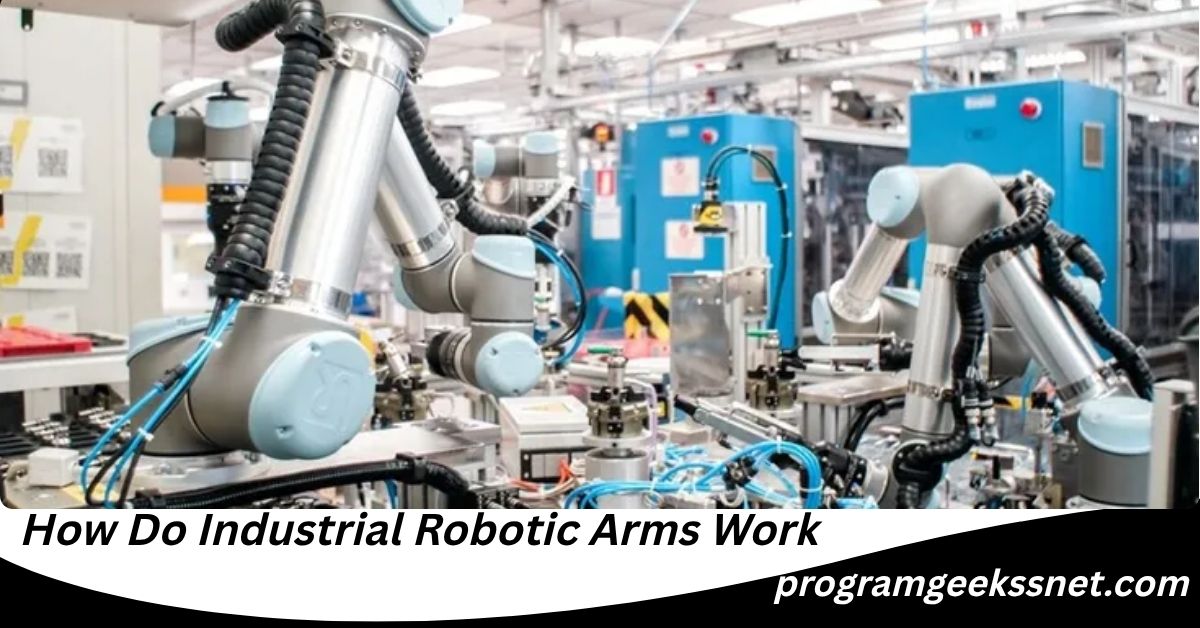
Industrial robotic arms are programmable mechanical devices designed to mimic the movement of a human arm. They are used in factories, warehouses, and production facilities to perform repetitive, dangerous, or highly precise tasks.
A robotic arm typically consists of multiple joints connected by links. These joints allow movement in different directions, enabling the robot to reach specific positions and perform tasks accurately.
Industrial robotic arms can:
- Lift heavy objects
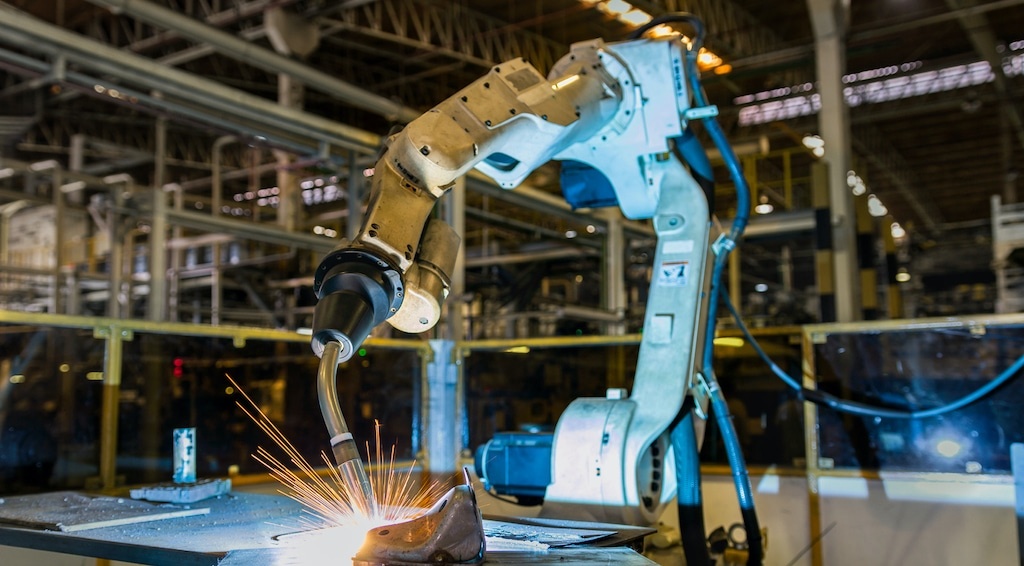
- Weld metal parts
- Paint surfaces
- Assemble products
- Package goods
- Inspect quality
- Sort materials
- Handle hazardous substances
Modern industrial robots can operate continuously for long periods while maintaining consistent quality and accuracy.
Why Are Industrial Robotic Arms Important?
Manufacturers face increasing pressure to produce goods faster, cheaper, and with fewer errors. Human workers are valuable, but repetitive tasks can lead to fatigue, mistakes, and safety risks.
Industrial robotic arms solve these challenges by providing:
- High-speed operation
- Consistent performance
- Improved safety
- Reduced production costs
- Better product quality
- Increased production capacity
As industries continue adopting automation, robotic arms have become a critical part of modern manufacturing systems.
How Do Industrial Robotic Arms Work?
The simplest answer to the question “how do industrial robotic arms work” is that they use motors, sensors, controllers, and software to move precisely and perform programmed tasks.
The process generally follows these steps:
Step 1: Receiving Instructions
Every robotic arm operates based on instructions.
These instructions come from:
- Robot programming software
- Manufacturing execution systems
- Artificial intelligence systems
- Human operators
- Automated production lines
The instructions tell the robot:
- Where to move
- How fast to move
- What action to perform
- When to stop
- How to interact with other machines
Step 2: Processing Commands
The robot controller acts as the robot’s brain.
Also Read: How Do You Make a Robot? A Complete Beginner-to-Advanced Guide for 2026
The controller receives commands and calculates:
- Joint positions
- Movement paths
- Speed settings
- Acceleration rates
- Safety parameters
Advanced controllers can perform thousands of calculations every second.
Step 3: Activating Motors
Once the controller determines the required movement, it sends signals to motors located at various joints.
These motors generate mechanical motion.
Common motor types include:
- Servo motors
- Stepper motors
- AC motors
- DC motors
Servo motors are most commonly used because they provide exceptional precision and control.
Step 4: Joint Movement
The motors rotate joints connected to mechanical links.
Each joint contributes a specific degree of movement.
As multiple joints move together, the robotic arm can reach almost any position within its work area.
This coordinated movement allows the robot to perform highly complex tasks.
Step 5: Sensor Feedback
Sensors constantly monitor the robot’s performance.
They provide information about:
- Position
- Speed
- Force
- Temperature
- Orientation
- Object location
The controller uses this feedback to make real-time adjustments.
Step 6: Completing the Task
At the end of the robotic arm is a tool called an end effector.
The end effector performs the actual work.
Examples include:
- Grippers
- Welding torches
- Paint sprayers
- Suction cups
- Cutting tools
- Inspection cameras
The robotic arm moves the end effector to the correct position and completes the assigned task.
Main Components of Industrial Robotic Arms
Understanding how industrial robotic arms work requires knowledge of their major components.
Base
The base provides stability and support.
It serves as the foundation of the robotic system and anchors the robot to the floor, wall, or ceiling.
Links
Links are the rigid sections connecting the joints.
They function similarly to human bones and determine the robot’s reach.
Joints
Joints connect the links and enable movement.
They act like human shoulders, elbows, and wrists.
Each joint increases the robot’s flexibility.
Actuators
Actuators generate movement.
Most industrial robots use electric actuators powered by servo motors.
Some specialized robots use hydraulic or pneumatic actuators.
Controller
The controller is the robot’s central computer.
It processes instructions and coordinates all movements.
Without the controller, the robotic arm cannot function.
Sensors
Sensors help the robot understand its environment.
Modern robots use various sensor types, including:
- Vision sensors
- Force sensors
- Proximity sensors
- Position sensors
- Laser scanners
End Effector
The end effector is the tool attached to the robot’s wrist.
It interacts directly with objects and performs the intended task.
Degrees of Freedom Explained
One important concept when learning how do industrial robotic arms work is degrees of freedom.
A degree of freedom refers to an independent movement axis.
The more degrees of freedom a robot has, the more flexible it becomes.
Examples:
- 1 degree of freedom = simple movement
- 3 degrees of freedom = basic positioning
- 6 degrees of freedom = human-like flexibility
- 7+ degrees of freedom = advanced maneuverability
Most industrial robotic arms have six degrees of freedom because this allows them to reach virtually any position and orientation within their workspace.
Types of Industrial Robotic Arms
Different robotic arm designs are optimized for different tasks.
Articulated Robots
Articulated robots resemble human arms.
They typically have multiple rotary joints.
Applications include:
- Welding
- Painting
- Assembly
- Material handling
They are the most common industrial robots worldwide.
Cartesian Robots
Cartesian robots move along straight X, Y, and Z axes.
They offer high accuracy and simple programming.
Common uses include:
- CNC operations
- Pick-and-place tasks
- Packaging
SCARA Robots
SCARA stands for Selective Compliance Assembly Robot Arm.
These robots are ideal for:
- Electronic assembly
- Fast pick-and-place operations
- Precision manufacturing
Delta Robots
Delta robots feature lightweight arms connected to a central base.
They are extremely fast.
Industries use them for:
- Food packaging
- Pharmaceutical production
- Sorting systems
Collaborative Robots
Collaborative robots, often called cobots, are designed to work safely alongside humans.
They use advanced sensors and safety features.
Applications include:
- Small-scale manufacturing
- Assembly assistance
- Machine tending
The Role of Sensors in Industrial Robotics
Sensors are critical to robotic performance.
Without sensors, robots would operate blindly.
Position Sensors
These sensors track joint angles and movement.
They ensure accurate positioning.
Vision Systems
Cameras allow robots to see objects.
Machine vision systems can:
- Identify products
- Detect defects
- Guide robotic movement
Force Sensors
Force sensors measure pressure and resistance.
They help robots handle delicate objects without causing damage.
Proximity Sensors
These sensors detect nearby objects and obstacles.
They improve workplace safety.
Temperature Sensors
Temperature sensors monitor equipment conditions and prevent overheating.
Robot Programming and Software
Programming is essential for robotic operation.
Engineers use specialized software to define:
- Motion paths
- Work sequences
- Safety zones
- Production schedules
Modern programming methods include:
Teach Pendant Programming
An operator manually guides the robot and records movements.
Offline Programming
Engineers create programs on a computer before deploying them to the robot.
AI-Based Programming
Artificial intelligence allows robots to learn from data and improve performance.
This technology is becoming increasingly common in advanced manufacturing facilities.
Also Read: How Do We Make a Robot? A Complete Beginner-to-Advanced Guide for 2026
How Artificial Intelligence Improves Robotic Arms
Artificial intelligence is changing industrial robotics dramatically.
Traditional robots follow fixed instructions.
AI-powered robots can:
- Adapt to changing environments
- Recognize objects
- Improve efficiency
- Predict maintenance needs
- Optimize movement paths
Machine learning allows robots to become smarter over time.
As AI technology advances, robotic arms are becoming more flexible and capable.
Common Industrial Applications
Industrial robotic arms are used across numerous industries.
Automotive Manufacturing
Automotive factories rely heavily on robotic arms.
Robots perform:
- Welding
- Painting
- Assembly
- Material handling
Electronics Manufacturing
Robots assemble small components with exceptional precision.
Food Processing
Food manufacturers use robots for:
- Packaging
- Sorting
- Palletizing
- Quality inspection
Aerospace Industry
Aircraft production requires extremely high accuracy.
Robotic arms help assemble complex components.
Pharmaceutical Manufacturing
Robots improve cleanliness and precision during medication production.
Logistics and Warehousing
Robotic systems assist with:
- Sorting packages
- Moving inventory
- Automated storage
The Science Behind Robot Movement
Industrial robotic arms rely on a field called kinematics.
Kinematics studies movement without considering force.
Engineers use two key concepts:
Forward Kinematics
Determines the end effector position based on joint angles.
Inverse Kinematics
Calculates required joint angles to reach a specific target position.
Inverse kinematics is particularly important because it allows robots to move accurately toward desired locations.
Advanced mathematical algorithms continuously solve these calculations.
Safety Systems in Industrial Robotics
Safety remains a top priority.
Modern robotic arms include multiple safety mechanisms.
Emergency Stop Systems
Instantly halt robot movement during emergencies.
Safety Sensors
Detect human presence and obstacles.
Speed Monitoring
Automatically reduces robot speed when humans are nearby.
Virtual Safety Zones
Software-defined boundaries prevent robots from entering dangerous areas.
Collision Detection
Identifies unexpected impacts and stops operation.
These systems significantly reduce workplace accidents.
Advantages of Industrial Robotic Arms
Industrial robots provide numerous benefits.
Increased Productivity
Robots can work continuously without breaks.
Improved Quality
Robots deliver consistent performance and reduce errors.
Enhanced Safety
Dangerous tasks can be automated.
Reduced Costs
Automation lowers labor and production expenses over time.
Better Precision
Robots achieve accuracy beyond human capabilities.
Scalability
Production capacity can increase without proportional workforce growth.
Challenges of Industrial Robotic Arms
Despite their advantages, robotic arms also present challenges.
High Initial Investment
Purchasing and installing robotic systems can be expensive.
Maintenance Requirements
Robots require regular servicing.
Technical Expertise
Specialized skills are needed for programming and maintenance.
Limited Flexibility
Some robots struggle with unexpected situations.
Integration Complexity
Connecting robots with existing systems may require significant planning.
Businesses must carefully evaluate these factors before implementation.
Industrial Robotics and Industry 4.0
Industry 4.0 refers to smart manufacturing powered by digital technologies.
Industrial robotic arms play a major role in this transformation.
Industry 4.0 technologies include:
- Artificial intelligence
- Internet of Things (IoT)
- Cloud computing
- Digital twins
- Big data analytics
Connected robots can communicate with machines, software, and operators in real time.
This creates more efficient and intelligent production environments.
Future Trends in Industrial Robotic Arms
The future of robotics is evolving rapidly.
Several trends are shaping the next generation of industrial robots.
Smarter AI Integration
Robots will make more autonomous decisions.
Advanced Machine Vision
Vision systems will become more accurate and intelligent.
Greater Human-Robot Collaboration
Cobots will work more closely with employees.
Predictive Maintenance
AI will identify problems before failures occur.
Digital Twin Technology
Virtual robot models will improve optimization and testing.
Autonomous Manufacturing
Factories will become increasingly self-managing.
These innovations will continue transforming industrial automation over the coming decade.
How Businesses Can Benefit from Robotic Arms
Companies considering automation should focus on long-term value rather than short-term costs.
Also Read: How Much Is the Robotic Dog? Complete 2026 Pricing Guide for Robot Dogs
Successful robotic implementation often results in:
- Faster production
- Higher customer satisfaction
- Better product consistency
- Reduced waste
- Improved profitability
Businesses that adopt robotic technologies early often gain competitive advantages in their industries.
Final Thoughts
If you have ever asked, “how do industrial robotic arms work,” the answer involves a fascinating combination of mechanics, electronics, software, sensors, and artificial intelligence.
Industrial robotic arms function by receiving instructions, processing data through advanced controllers, activating motors, coordinating joint movements, gathering sensor feedback, and performing tasks through specialized end effectors. This process allows them to execute complex operations with remarkable precision, speed, and reliability.
As manufacturing continues to evolve, industrial robotic arms will become even smarter, safer, and more capable. Their role in modern industry is no longer optional for many businesses—it is becoming a fundamental requirement for staying competitive in a rapidly changing global economy.
Understanding how industrial robotic arms work provides valuable insight into one of the most important technologies shaping the future of manufacturing, logistics, healthcare, aerospace, and countless other industries.
Frequently Asked Questions (FAQs)
How long do industrial robotic arms typically last?
Most industrial robotic arms can operate for 10 to 20 years or more when properly maintained. Regular servicing, software updates, and replacement of worn components help extend their lifespan.
Can industrial robotic arms work 24 hours a day?
Yes. Many industrial robots operate around the clock in multiple shifts. Scheduled maintenance is usually the only downtime required.
What programming languages are used for industrial robots?
Different manufacturers use different languages. Common examples include RAPID, KRL, VAL3, and specialized robot programming environments.
How accurate are industrial robotic arms?
Many modern industrial robots achieve accuracy within fractions of a millimeter, making them ideal for precision manufacturing tasks.
Do industrial robotic arms replace human workers?
Robots typically automate repetitive and hazardous tasks. In many cases, workers move into higher-value roles involving supervision, maintenance, programming, and quality control.
What industries use robotic arms the most?
Automotive, electronics, aerospace, logistics, pharmaceuticals, food processing, and consumer goods manufacturing are among the largest users of robotic arm technology.
Can small businesses afford industrial robotic arms?
Yes. The rise of collaborative robots and flexible automation solutions has made robotic technology more affordable for small and medium-sized businesses.
How much weight can industrial robotic arms lift?
Payload capacity varies widely. Some robots lift only a few pounds, while heavy-duty industrial robots can handle several thousand pounds.
What happens if a robotic arm loses power?
Most industrial robots have safety systems that stop movement safely and protect equipment and workers during power interruptions.
Will AI completely control future industrial robots?
AI will play a larger role in decision-making and optimization, but human oversight will remain important for safety, strategy, and operational management.
editor's pick
latest video

news via inbox
Nulla turp dis cursus. Integer liberos euismod pretium faucibua