What Is an Industrial Robot? A Complete Guide to Industrial Robots, Their Types, Uses, Benefits, and Future
If you have ever wondered, “what is an industrial robot?” you are not alone. Industrial robots have become one of the most important technologies in modern manufacturing. They help companies produce products faster, improve quality, reduce workplace injuries, and lower production costs.
Today, industrial robots are used in industries such as automotive manufacturing, electronics, food processing, pharmaceuticals, aerospace, logistics, metal fabrication, and many more. These intelligent machines have transformed the way factories operate and continue to evolve with artificial intelligence (AI), machine learning, computer vision, and smart automation.
Understanding what is an industrial robot is important because automation is shaping the future of work. Whether you are a student, business owner, engineer, factory manager, or someone interested in technology, learning about industrial robots can help you understand how modern industries achieve higher productivity and better product quality.
This complete guide explains everything you need to know in simple language, including how industrial robots work, their components, types, applications, advantages, disadvantages, costs, future trends, and much more.
What Is an Industrial Robot?
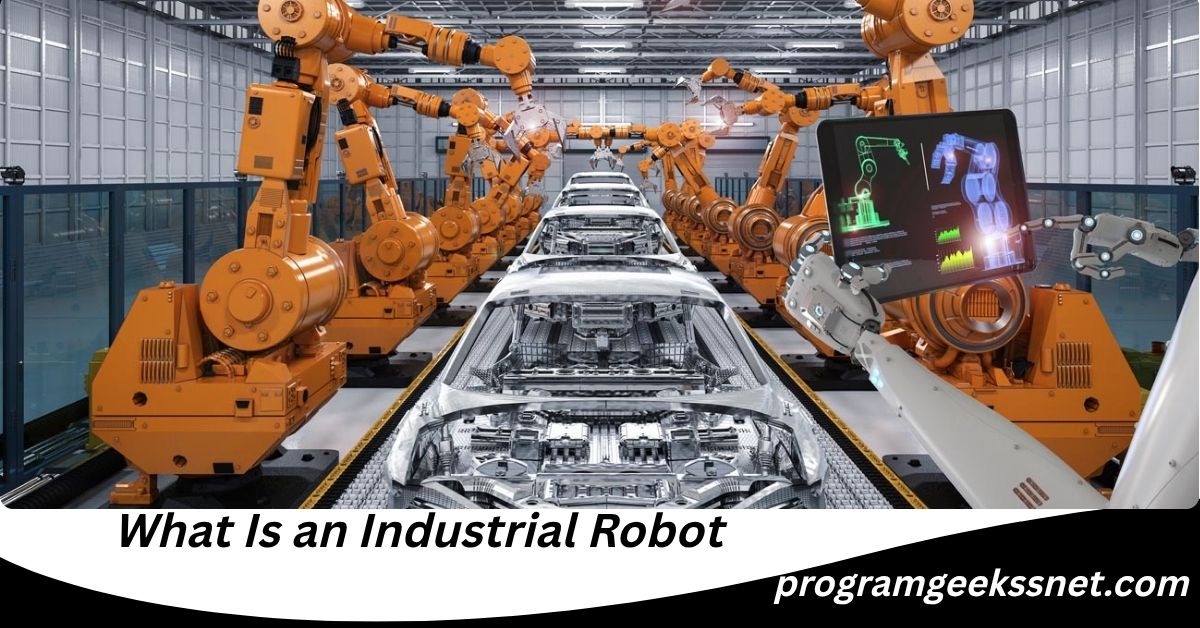
An industrial robot is a programmable mechanical machine designed to perform manufacturing or industrial tasks automatically. It can move materials, operate machinery, assemble products, weld components, paint surfaces, inspect quality, package goods, and complete many other repetitive or dangerous tasks with high precision.
Unlike simple machines that perform one fixed operation, industrial robots can be programmed to perform different tasks depending on business needs. Many robots can work continuously for long hours with very little downtime.
Industrial robots usually operate inside factories and production facilities where speed, consistency, and safety are critical.
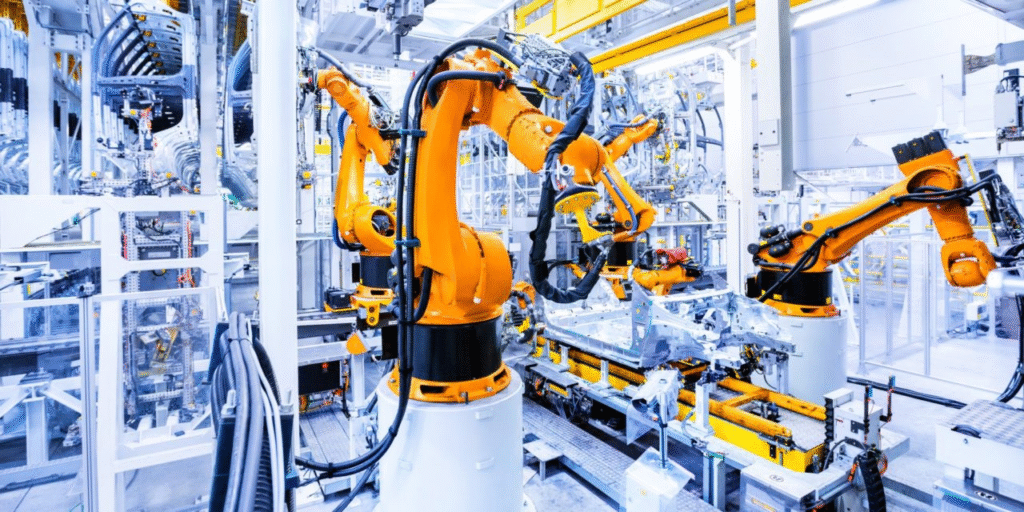
In simple words, if someone asks, “what is an industrial robot,” the easiest answer is:
An industrial robot is an automated machine that performs manufacturing tasks accurately, safely, and efficiently with little or no human intervention.
Definition of an Industrial Robot
According to internationally recognized industrial standards, an industrial robot is an automatically controlled, programmable, multi-purpose machine capable of moving on three or more axes.
This definition highlights several important features:
- Programmable
- Reprogrammable
- Multi-purpose
- Automatic operation
- Multiple movement directions
- High precision
- Industrial applications
These characteristics separate industrial robots from ordinary machines.
History of Industrial Robots
Industrial robotics has developed over several decades.
Early Automation
Before robots existed, factories relied almost entirely on human workers. Machines improved productivity, but many jobs remained repetitive and physically demanding.
The First Industrial Robot
The first commercially successful industrial robot was Unimate, introduced in the early 1960s. It worked in automobile manufacturing by moving hot metal parts that were dangerous for workers.
This marked the beginning of robotic automation.
Growth During the 1980s
As computers became more powerful, robots gained better programming capabilities, higher accuracy, and improved reliability. More industries began adopting robotic systems.
Also Read: How Do Industrial Robots Work in Factories? A Complete Guide to Modern Factory Automation
Modern Industrial Robots
Today’s industrial robots include advanced technologies such as:
- Artificial Intelligence
- Machine Vision
- Internet of Things (IoT)
- Cloud Computing
- Real-Time Monitoring
- Digital Twins
- Predictive Maintenance
- Machine Learning
Modern robots are faster, smarter, and more flexible than ever before.
How Does an Industrial Robot Work?
Understanding what is an industrial robot also means understanding how it performs its tasks.
Although different robots have different designs, most work through the same basic process.
Step 1: Receiving Instructions
The robot receives instructions through software programming. Engineers create programs that tell the robot exactly what actions to perform.
Step 2: Sensors Collect Information
Sensors detect:
- Position
- Distance
- Objects
- Temperature
- Pressure
- Force
- Motion
This information helps the robot understand its environment.
Step 3: Controller Processes Data
The controller acts as the robot’s brain.
It analyzes incoming information and decides the next movement.
Step 4: Motors Move the Robot
Electric motors power each robotic joint.
These joints move together to create smooth, accurate motion.
Step 5: End Effector Performs the Task
The end effector is attached to the robot arm.
Examples include:
- Grippers
- Welding torches
- Paint sprayers
- Vacuum cups
- Screwdrivers
- Cutting tools
- Laser scanners
The robot uses the appropriate tool depending on the application.
Main Components of an Industrial Robot
Every industrial robot contains several essential components.
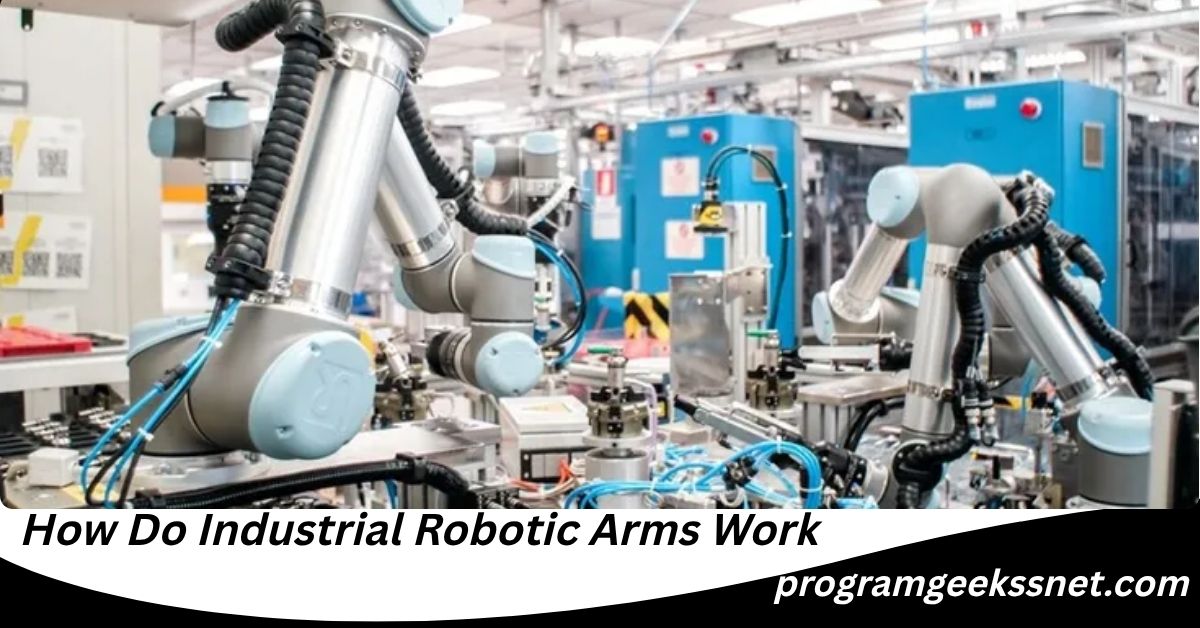
Robot Arm
The robotic arm performs movement.
It usually includes multiple joints that imitate the movement of a human arm.
Controller
The controller is the computer that manages every robot movement.
It executes programs and coordinates operations.
End Effector
This is the working tool attached to the robot.
Without an end effector, the robot cannot perform useful work.
Sensors
Sensors improve accuracy and safety.
Common sensors include:
- Vision sensors
- Force sensors
- Proximity sensors
- Position sensors
- Temperature sensors
Drive System
The drive system provides movement.
Industrial robots commonly use:
- Electric motors
- Servo motors
- Hydraulic systems
- Pneumatic systems
Power Supply
Every robot requires a reliable power source to operate continuously.
Types of Industrial Robots
Different industries require different robot designs.
Articulated Robots
Articulated robots are the most common industrial robots.
They resemble a human arm and usually have four to seven axes.
Applications include:
- Welding
- Painting
- Assembly
- Material handling
- Machine tending
Their flexibility makes them suitable for many industries.
SCARA Robots
SCARA stands for Selective Compliance Assembly Robot Arm.
These robots specialize in:
- Electronics assembly
- Packaging
- Pick-and-place operations
They provide extremely fast horizontal movement.
Cartesian Robots
Cartesian robots move along straight X, Y, and Z axes.
They are commonly used for:
- CNC machines
- 3D printing
- Precision assembly
- Material transport
Delta Robots
Delta robots have lightweight arms connected to a fixed base.
They are among the fastest industrial robots available.
Industries use them for:
- Food packaging
- Pharmaceutical packaging
- Sorting
- Pick-and-place
Cylindrical Robots
These robots move in cylindrical coordinates.
Applications include:
- Machine loading
- Assembly
- Material handling
Polar Robots
Polar robots rotate around a central base.
They are useful for large workspaces requiring wide movement.
Collaborative Robots (Cobots)
Collaborative robots are designed to safely work alongside humans.
Unlike traditional robots that require safety cages, cobots include advanced sensors that detect nearby workers.
They are becoming increasingly popular among small and medium-sized manufacturers because they are easier to install and program.
Industrial Robot Axes Explained
Industrial robots move using axes.
Each axis adds another degree of movement.
Typical movements include:
- Base rotation
- Shoulder movement
- Elbow movement
- Wrist rotation
- Wrist bending
- Tool rotation
More axes generally allow greater flexibility.
Most modern industrial robots have six axes.
Industrial Robot Programming
Programming tells the robot exactly what to do.
Common programming methods include:
Teach Pendant Programming
An operator manually moves the robot using a handheld controller.
The robot records each position.
Offline Programming
Engineers create robot programs on a computer before transferring them to the robot.
This reduces production downtime.
AI-Based Programming
Artificial intelligence allows robots to learn tasks more efficiently.
Some systems automatically optimize movement patterns for better performance.
Industries That Use Industrial Robots
Industrial robots now serve nearly every manufacturing sector.
Major industries include:
- Automotive
- Aerospace
- Electronics
- Food processing
- Beverage manufacturing
- Pharmaceuticals
- Medical devices
- Plastics
- Metal fabrication
- Warehousing
- Logistics
- Consumer products
- Semiconductor manufacturing
- Furniture production
- Packaging industries
Each industry uses robots to improve efficiency while maintaining consistent quality.
Common Applications of Industrial Robots
Industrial robots perform thousands of different tasks.
Some of the most common include:
Welding
Robots produce highly consistent welds while reducing worker exposure to heat and sparks.
Painting
Robotic painting delivers even coatings while reducing paint waste.
Assembly
Robots assemble products quickly with excellent precision.
Pick and Place
Robots move products between different stages of production.
Packaging
Packaging robots increase speed while reducing repetitive manual work.
Palletizing
Robots stack boxes onto pallets in organized patterns.
Machine Tending
Robots load and unload CNC machines automatically.
Quality Inspection
Vision systems inspect products for defects that human eyes might miss.
Material Handling
Heavy materials can be transported safely without worker injuries.
Advantages of Industrial Robots
Industrial robots provide numerous benefits for manufacturers.
Higher Productivity
Robots can operate continuously with minimal breaks, increasing overall production output.
Improved Product Quality
Because robots repeat the same movements precisely, they reduce variations and defects.
Better Workplace Safety
Dangerous tasks such as welding, heavy lifting, and handling hazardous materials can be assigned to robots, lowering the risk of workplace injuries.
Lower Operating Costs
Although the initial investment may be high, robots often reduce long-term labor, waste, and maintenance costs.
Increased Precision
Industrial robots can perform tasks with exceptional accuracy, making them ideal for industries that require tight tolerances.
Consistent Performance
Unlike humans, robots do not become tired or distracted, ensuring consistent quality throughout production shifts.
Reduced Waste
Accurate movements help reduce material waste and improve resource efficiency.
Greater Flexibility
Modern robots can often be reprogrammed to perform new tasks, allowing manufacturers to adapt to changing production needs.
Disadvantages of Industrial Robots
Although industrial robots offer many advantages, they also come with some challenges. Understanding both the benefits and limitations helps businesses make informed decisions before investing in automation.
High Initial Investment
One of the biggest challenges is the upfront cost. Purchasing robots, installing them, integrating software, and training employees require a significant investment. While many companies recover these costs over time through increased productivity, the initial expense can be difficult for smaller businesses.
Maintenance Requirements
Industrial robots require regular maintenance to keep them operating at peak performance. Motors, sensors, controllers, and end effectors should be inspected and serviced to avoid unexpected downtime.
Skilled Workers Are Needed
Although robots reduce manual labor, they increase the need for skilled workers who can program, monitor, repair, and maintain robotic systems.
Limited Creativity
Robots excel at repetitive tasks, but they cannot replace human creativity, problem-solving, or complex decision-making in most situations.
Production Stops During Failures
If a robot experiences a technical issue, production may stop until the problem is resolved. This is why preventive maintenance is essential.
Industrial Robot Safety
Safety is one of the most important aspects of industrial robotics. Modern robots are designed with multiple safety features that protect workers while maintaining high productivity.
Also Read: How Do Industrial Robotic Arms Work? A Complete Guide to Industrial Robot Technology in 2026
Common safety measures include:
- Emergency stop buttons
- Safety fences
- Laser scanners
- Light curtains
- Motion sensors
- Safety-rated controllers
- Collision detection systems
- Speed monitoring
- Restricted work zones
Factories also train employees to work safely around robotic equipment. Regular inspections and safety audits help ensure robots operate correctly.
Collaborative robots have added another level of safety by automatically slowing down or stopping when they detect nearby people.
Industrial Robot Accuracy and Precision
One reason manufacturers invest in industrial robots is their remarkable accuracy.
Many industrial robots can repeatedly move to the exact same position with only tiny variations. This consistency improves product quality and reduces manufacturing defects.
Industries that depend on extremely high precision include:
- Electronics manufacturing
- Medical device production
- Aerospace engineering
- Semiconductor manufacturing
- Automotive assembly
Consistent accuracy also helps reduce material waste, saving companies money over time.
Industrial Robots and Artificial Intelligence
Artificial Intelligence (AI) is changing what industrial robots can do.
Traditional robots follow pre-programmed instructions. AI-powered robots can analyze information, recognize patterns, and make limited decisions based on real-time conditions.
Examples include:
Machine Vision
AI allows robots to identify products, read labels, detect defects, and recognize different shapes using cameras.
Predictive Maintenance
AI analyzes robot performance to predict when maintenance will be needed before a failure occurs.
Smart Quality Control
Instead of checking only a sample of products, AI-enabled robots can inspect every item produced.
Adaptive Learning
Some robots improve their performance by learning from previous operations, allowing them to work more efficiently over time.
AI does not replace industrial robots—it makes them smarter, more flexible, and more capable of handling complex manufacturing tasks.
Industrial Robots and Industry 4.0
Industry 4.0 refers to the next generation of manufacturing, where machines, robots, sensors, and software work together through connected digital systems.
Industrial robots are one of the core technologies behind Industry 4.0.
Key technologies include:
- Artificial Intelligence
- Internet of Things (IoT)
- Cloud Computing
- Big Data Analytics
- Machine Learning
- Digital Twins
- Smart Sensors
- Edge Computing
These technologies allow factories to monitor production in real time, improve efficiency, and respond quickly to changing customer demands.
Industrial Robot Software
Industrial robots rely on specialized software to perform their tasks.
This software helps engineers:
- Program movements
- Monitor robot health
- Simulate production lines
- Detect errors
- Optimize cycle times
- Coordinate multiple robots
Many manufacturers also use digital simulation software to test production before installing robots on the factory floor.
This reduces installation time and minimizes costly mistakes.
Industrial Robot End Effectors
The end effector is often called the robot’s “hand.”
Different jobs require different tools.
Common end effectors include:
Mechanical Grippers
Used for holding and moving parts.
Vacuum Grippers
Ideal for lifting flat objects such as glass, plastic sheets, and cardboard.
Welding Guns
Used in automotive and metal fabrication industries.
Paint Sprayers
Provide even paint coverage while reducing waste.
Screwdrivers
Automatically tighten screws during assembly.
Cutting Tools
Perform laser cutting, plasma cutting, or waterjet cutting.
Polishing Tools
Create smooth finishes on metal, plastic, or other materials.
Changing the end effector allows one robot to perform completely different tasks.
Industrial Robots vs. Collaborative Robots
People often confuse industrial robots with collaborative robots, also called cobots.
Although both automate work, they are designed for different environments.
Industrial Robots
- Built for speed and heavy-duty work
- Usually operate inside safety cages
- Handle large payloads
- Used for high-volume production
- Require professional programming
Collaborative Robots
- Designed to work near people
- Include advanced safety features
- Easier to program
- Better for smaller production runs
- Often used by small and medium-sized businesses
Choosing between the two depends on production requirements, workspace, and budget.
How Much Does an Industrial Robot Cost?
The cost of an industrial robot varies depending on several factors, including its size, payload capacity, speed, software, and accessories.
A basic robotic system may cost tens of thousands of dollars, while advanced robotic cells with vision systems, conveyors, and AI capabilities can cost several hundred thousand dollars.
Businesses should also consider additional costs such as:
- Installation
- Programming
- Employee training
- Maintenance
- Safety equipment
- Software licenses
- Integration with existing machinery
Although the investment may seem high, many companies achieve a positive return through increased productivity, reduced waste, and lower operating costs.
How Businesses Choose the Right Industrial Robot
Selecting the right robot requires careful planning.
Important factors include:
Payload Capacity
The robot must safely lift the required weight.
Reach
The arm should be long enough to access every part of the work area.
Speed
Production goals determine how quickly the robot must operate.
Accuracy
Some industries require extremely precise movement.
Environment
Robots used in food processing or pharmaceutical production may require special hygienic designs.
Integration
The robot should work smoothly with existing equipment and software.
Future Expansion
Businesses should choose systems that can adapt as production grows.
Future of Industrial Robots
The future of industrial robotics looks extremely promising.
Several trends are shaping the next generation of automation.
Smarter Artificial Intelligence
Future robots will make faster decisions using improved AI algorithms.
Better Human-Robot Collaboration
Cobots will become even safer and easier to use alongside human workers.
Mobile Industrial Robots
Autonomous mobile robots will transport materials throughout factories without fixed pathways.
Cloud Robotics
Robots will share information through cloud platforms, allowing continuous improvements and remote monitoring.
Digital Twins
Factories will create virtual copies of production lines to test improvements before making physical changes.
Green Manufacturing
Industrial robots will help reduce energy consumption, material waste, and carbon emissions through optimized production.
Easier Programming
Programming robots will become simpler, allowing workers with little technical experience to automate tasks quickly.
Common Myths About Industrial Robots
Several misconceptions still exist about industrial robots.
Myth 1: Robots Replace Every Human Job
Reality: Robots replace repetitive tasks, while humans continue to perform planning, creativity, supervision, engineering, maintenance, and customer-focused work.
Myth 2: Only Large Companies Use Robots
Reality: Affordable collaborative robots have made automation accessible for many small and medium-sized businesses.
Myth 3: Robots Never Make Mistakes
Reality: Robots can make errors if they are programmed incorrectly or if sensors fail. Regular maintenance and quality checks remain important.
Myth 4: Robots Work Without Human Help
Reality: Engineers, technicians, programmers, and operators are essential for installing, maintaining, and improving robotic systems.
Expert Insights
Industrial robots are no longer limited to automobile factories. Advances in AI, sensors, and automation have expanded their role across nearly every manufacturing sector.
Also Read: How Do You Make a Robot? A Complete Beginner-to-Advanced Guide for 2026
Companies that successfully implement robotics usually focus on improving worker productivity rather than replacing employees. Robots perform repetitive, physically demanding, or hazardous tasks, while people handle responsibilities requiring judgment, communication, and innovation.
Businesses that combine skilled employees with intelligent automation often achieve the best long-term results.
Frequently Asked Questions (FAQs)
What is an industrial robot in simple words?
An industrial robot is a programmable machine that automatically performs manufacturing tasks such as welding, assembling, packaging, and moving materials.
Where are industrial robots used?
They are used in automotive, electronics, aerospace, food processing, pharmaceutical, logistics, metal fabrication, and many other industries.
Can industrial robots work continuously?
Yes. Many industrial robots can operate 24 hours a day with scheduled maintenance and supervision.
What powers an industrial robot?
Most industrial robots use electric servo motors, although some use hydraulic or pneumatic systems.
What is the difference between automation and robotics?
Automation is the process of using technology to perform tasks automatically. Robotics is one type of automation that uses programmable machines.
Do industrial robots need programming?
Yes. Every industrial robot must be programmed to perform its assigned tasks accurately.
Are industrial robots safe?
Yes. Modern robots include multiple safety systems, and factories follow strict safety procedures to protect workers.
Can small businesses use industrial robots?
Yes. Many affordable robotic systems and collaborative robots are designed specifically for small and medium-sized companies.
What skills are needed to work with industrial robots?
Useful skills include robotics programming, electrical engineering, mechanical maintenance, automation, PLC programming, and computer science.
Conclusion
Understanding what is an industrial robot is essential for anyone interested in modern manufacturing and automation. Industrial robots have evolved from simple machines that performed repetitive movements into intelligent systems capable of handling complex tasks with remarkable speed, precision, and reliability.
Today, they are found in factories around the world, helping produce everything from automobiles and airplanes to smartphones, medical devices, packaged foods, and consumer products. Their ability to work continuously, improve product quality, reduce workplace injuries, and support sustainable manufacturing has made them a vital part of modern industry.
Looking ahead, advances in artificial intelligence, machine vision, cloud computing, and connected manufacturing will make industrial robots even more capable. Rather than replacing human workers entirely, these technologies are creating new opportunities for people to focus on higher-value tasks that require creativity, critical thinking, and technical expertise.
For businesses, investing in industrial robotics is increasingly becoming a strategic decision that supports long-term growth, efficiency, and competitiveness. For students and professionals, learning about industrial robots opens the door to exciting careers in automation, engineering, software development, and advanced manufacturing.
As technology continues to evolve, industrial robots will remain at the center of smarter, safer, and more efficient production systems, shaping the future of manufacturing for decades to come.
editor's pick
latest video

news via inbox
Nulla turp dis cursus. Integer liberos euismod pretium faucibua